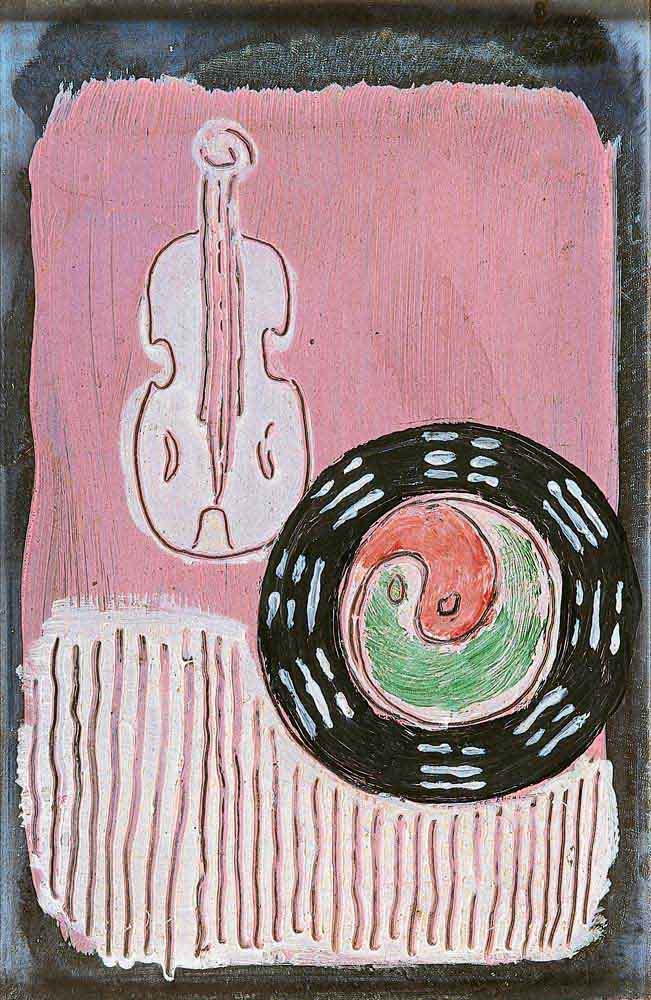
Violin and the Eight Trigrams by Sanyu, a small pink still life with a white violin and a black circular bagua diagram

Sanyu / 常玉

Sanyu

The painter who made the body, a flower, or a lone animal feel like one unrepeatable stroke.

Begin the life story
01

Violin and the Eight Trigrams1929/1932

1895-1966Nanchong / Berlin / ParisOil / Ink / Drawing / PrintSchool of Paris modernism

01 / Biography

A life shaped by calligraphy, migration, patronage, and precarity.

Sanyu did not simply decorate Parisian subjects with Chinese line. He rebuilt the nude, still life, and animal painting around the speed of the brush and the pressure of empty space.

Sanyu's images look effortless only because decades of drawing taught him how much a single contour could hold.

1895-1921

Nanchong, silk, calligraphy, and a disputed birth year

The Li Ching Foundation gives Sanyu's birth as October 14, 1895, in Nanchong, Sichuan, while French museum records often use 1900 or 1901. He grew up in a prosperous family whose Dehe Silk Factory was managed by his much older brother Chang Junmin. Junmin supported the youngest son's education and artistic interests. Sanyu studied calligraphy with the respected Sichuan master Zhao Xi and learned painting from his father, who was known locally for images of lions and horses. This early formation mattered: line was not merely an outline but a disciplined action with speed, weight, and character. After time in Shanghai and Japan, Sanyu joined the larger Republican-era movement of Chinese students and artists traveling abroad. He reached France in 1921 amid the intellectual energy created by May Fourth reform and the Diligent Work-Frugal Study movement.

1921-1929

Berlin, Montparnasse, and the discovery of the nude

Sanyu spent roughly two years in Berlin with Chinese friends including Xu Beihong and Jiang Biwei, then returned to Paris in 1923. Instead of entering the official Ecole des Beaux-Arts, he worked at the less formal Academie de la Grande Chaumiere. There, life models and open studio sessions offered a subject largely unavailable in his earlier education. More than two thousand figure drawings survive from his Paris years. Many were made with Chinese brush and ink, sometimes on cafe placemats, and reduce the body to a few elastic strokes. Montparnasse also gave Sanyu a social world of cafes, artists, writers, and models. He met Marcelle Charlotte Guyot de la Hardrouyere at the academy; they married in the mid-1920s, but financial strain and personal conflict eventually ended the marriage.

1929-1938

Roche, oil painting, salons, and sudden precarity

In 1929 Sanyu met the writer, collector, and dealer Henri-Pierre Roche, who encouraged him to move from drawing and printmaking into oil. Roche acquired 111 paintings and roughly 600 drawings, and Sanyu began showing oils at Paris salons. His first dated oil is from 1929. The new medium did not erase the logic of calligraphy: he scratched through paint, used broad flat grounds, and let contour carry the image. Stability was brief. The global depression weakened the market; Junmin died in 1931, ending family support; Roche broke off their arrangement; and Marcelle left. Dutch composer Johan Franco became a patron and organized exhibitions in the Netherlands, but sales remained limited. Chinese peers still recognized Sanyu as an important modernist, inviting him into discussions around the Storm Society and including his work in a 1933 exhibition at the Jeu de Paume.

1938-1950

War, material scarcity, ping-tennis, and Robert Frank

The late 1930s and the occupation of France intensified Sanyu's poverty. At times he lacked money for canvas and paint, making small plaster sculptures and pursuing an invented sport he called ping-tennis. The project was not a comic sideline to him; he hoped its success might provide the recognition and income painting had not. Sanyu continued to exhibit in salons and publish short texts, but remained marginal to the commercial system around the School of Paris. In 1948 he traveled to New York to promote ping-tennis and met the young photographer Robert Frank. They became roommates and close friends. Frank organized a 1950 exhibition, but no paintings sold. When Sanyu returned to Paris, he left a group of works with Frank, establishing one of the most consequential archives of his postwar painting.

1950-1966

Late painting, solitude, and the exhibition that never happened

Back in Paris, Sanyu survived through odd jobs including furniture painting and carpentry. Postwar attention was shifting toward abstraction, yet he remained committed to nudes, flowers, fish, and animals. Those familiar subjects changed sharply. Grounds grew darker or more exposed; figures became monumental outlines; animals appeared isolated in landscapes larger than any plausible habitat. Friends including Robert Frank and Alberto Giacometti remained important, but Sanyu was increasingly withdrawn. In 1963 Taiwan's education minister Huang Jilu invited him to teach and hold a solo exhibition. Sanyu sent more than forty paintings to Taipei, but travel and exhibition plans failed. In August 1966 he died from accidental gas asphyxiation in his Paris studio, reportedly found in bed with a book open beside him.

After 1966

Taipei, conservation, and a posthumous public life

The paintings sent toward the unrealized Taiwan exhibition became the core of the National Museum of History's Sanyu holdings, now the most substantial public collection of his oils. The museum later conserved forty-nine works and designated Four Nudes on a Gold Carpet and Chrysanthemum as significant antiquities. Robert Frank preserved another crucial group and, after selling it in 1997, used the proceeds to establish a scholarship for Chinese art students at Yale. Scholarship, catalogue raisonne research, Asian museum exhibitions, and the 2004 Guimet retrospective gradually replaced the romantic image of an unknown bohemian with a fuller record of artistic labor, transnational friendship, and uneven recognition. Sanyu's market prominence arrived late; his historical importance rests in how radically he made brush line, oil paint, the body, and empty space belong together.

02 / Selected works

Ten works, each with its own kind of silence.

Read across mirrors, canvas, and masonite to see how Sanyu moved from intimate Paris pictures toward monumental bodies, dark flowers, and exposed animal landscapes.

Violin and the Eight Trigrams by Sanyu, a small pink still life with a white violin and a black circular bagua diagram
Image reference: Li Ching Foundation Sanyu archive. Educational presentation.

01 / 1929/1932

Violin and the Eight Trigrams

A Paris still life carries a Chinese cosmos

This tiny painting places a violin beside the Eight Trigrams and a taiji diagram. The objects are not rendered with academic volume. They sit like signs on a pink field, held together by incised contours, a striped lower band, and the reflective support of a mirror.

The combination is more than an easy East-West symbol. A European instrument, an ancient cosmological diagram, and a modern domestic surface become equally available shapes. Sanyu treats cultural references as parts of one lived visual vocabulary rather than as opposites to reconcile.

Look closely

  • The violin reduced to a continuous, almost calligraphic contour
  • The bagua ring behaving as both symbol and bold abstract circle
  • Scratched lines that let the mirror support interrupt the paint
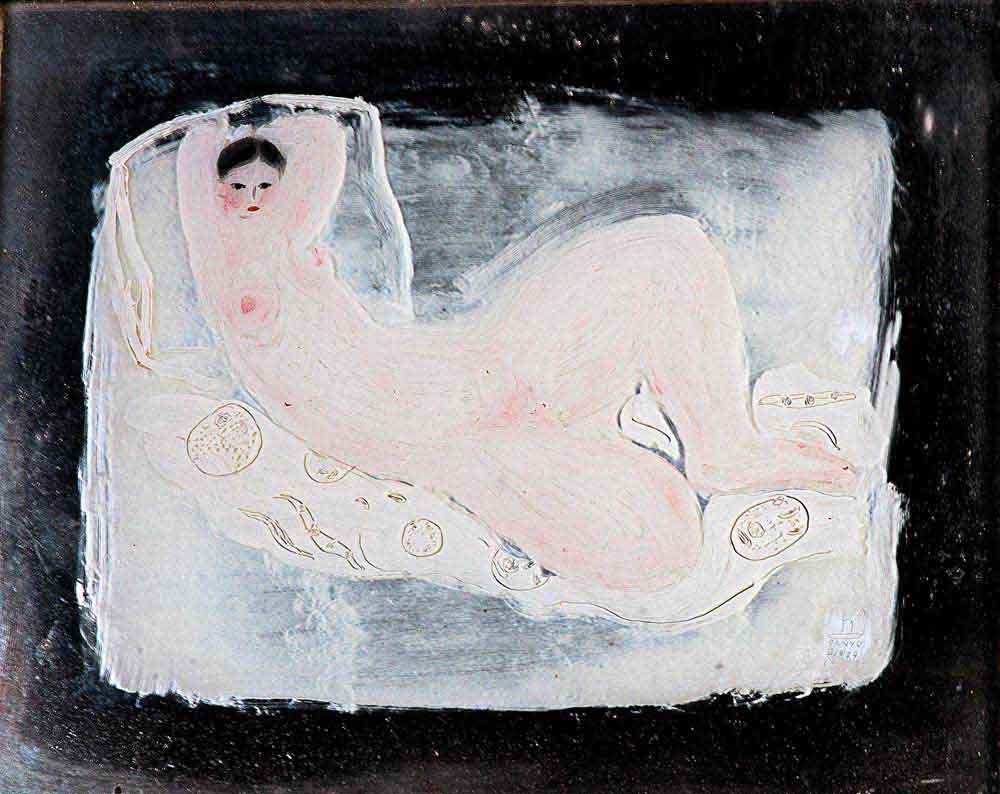
Reclining Pink Nude by Sanyu, a pale reclining figure on a patterned sheet within a black painted border
Image reference: Li Ching Foundation Sanyu archive. Educational presentation.

02 / 1929

Reclining Pink Nude

The nude becomes a single swelling line

Although the work is physically small, the body fills almost the entire inner field. Pale pink and white merge across the torso while a dark painted border closes around it. The figure is less modeled than expanded, its proportions directed by the movement of contour rather than academic anatomy.

Sanyu had spent years drawing models with ink and brush at the Grande Chaumiere. In oil, that training survives as economy: one curve can describe shoulder, waist, hip, and leg. The patterned sheet keeps the scene decorative and flat even as the body presses toward the viewer.

Look closely

  • The exaggerated arc from the waist into the raised hip
  • Small floral and fruit motifs scattered under the body
  • A face reduced to a few marks while the contour carries expression
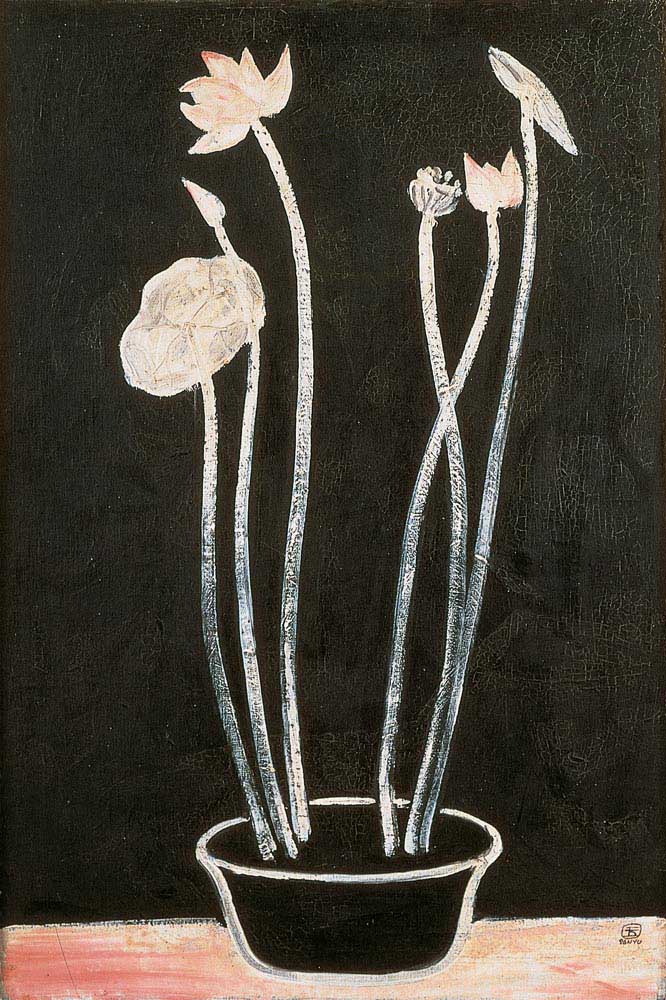
Pink and White Lotus by Sanyu, five long pale lotus stems rising from a black pot against a black field
Image reference: Li Ching Foundation Sanyu archive. Educational presentation.

03 / 1934

Pink and White Lotus

Flowers stand inside an ink-black night

Five lotus stems rise from a squat pot against a nearly black ground. The pale stems cross and separate like drawn lines, while the blossoms are only lightly tinted pink. The plant is legible, but the composition is built from intervals, vertical rhythms, and the pressure of empty dark space.

Lotus imagery carried long associations with purity in Chinese art, yet Sanyu avoids the atmosphere of a traditional ink scroll. Thick oil, crackled surface, and a cropped tabletop place the motif in a modern still life. Cultural memory is present as material and rhythm, not quotation.

Look closely

  • Stems crossing without creating a conventional sense of depth
  • The black pot almost disappearing into the background
  • Pink accents so restrained that the white flowers seem luminous
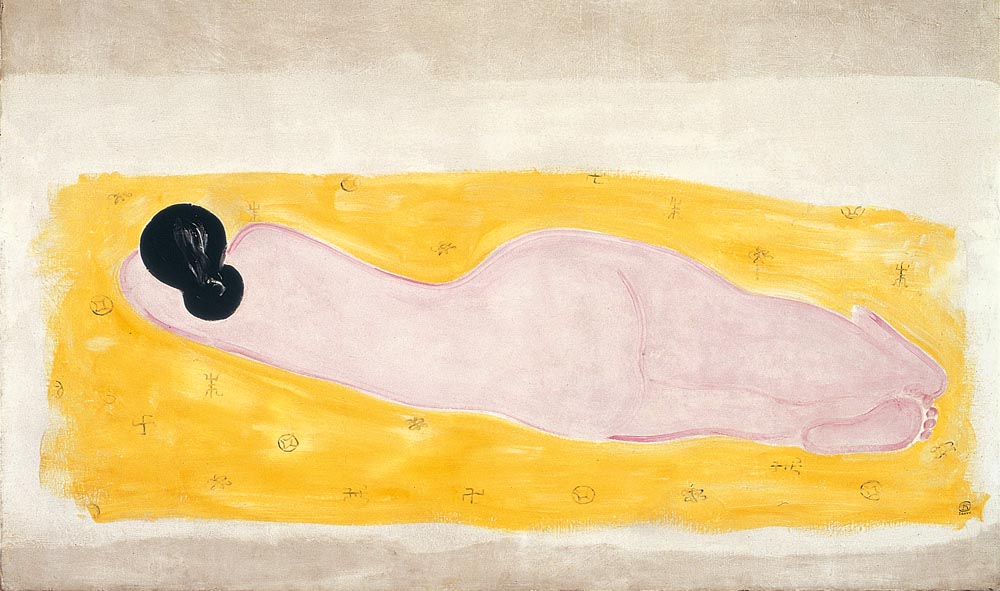
Nude on Yellow Tapestry by Sanyu, a pink figure viewed from behind stretched across a yellow patterned field
Image reference: Li Ching Foundation Sanyu archive. Educational presentation.

04 / 1930s

Nude on Yellow Tapestry

Body and carpet occupy the same plane

A back-turned figure stretches horizontally across a yellow tapestry. Sanyu suppresses conventional depth: the carpet rises behind the body like a field of color, and tiny decorative signs sit on its surface without obeying scale or perspective.

The pose is erotic yet withheld. The face disappears into a compact black knot of hair, while a thin pink contour carries the body from shoulder to foot. Figure, textile, and painted ground become one continuous ornamental structure.

Look closely

  • The long unbroken contour across the back and legs
  • Tiny carpet signs interrupting the yellow without receding
  • Bare canvas surrounding the central field like an unfinished margin
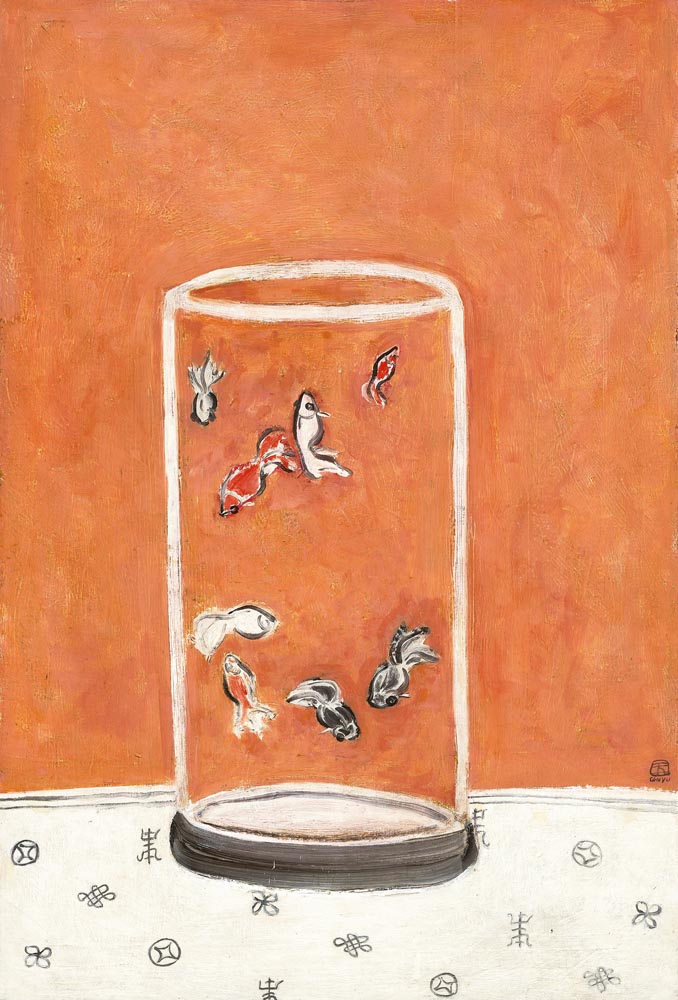
Goldfish by Sanyu, a transparent cylindrical aquarium with small fish against an orange field
Image reference: Li Ching Foundation Sanyu archive. Educational presentation.

05 / 1945/1948

Goldfish

A glass cylinder holds a suspended world

A white outline defines a cylindrical aquarium against a field of burnt orange. The water itself is almost impossible to locate; instead, seven fish hover at different angles inside the transparent vessel. The tabletop below carries scattered signs that rhyme with their flicking tails.

Made around the end of the Second World War, the painting uses a restricted palette and deliberately rough surface. An auspicious subject associated with abundance becomes intimate and precarious. The fish have room to move, but their world is visibly bounded.

Look closely

  • White elliptical lines making the glass appear without shading
  • Fish distributed like animated punctuation marks
  • The same orange passing through background, water, and reflection
Black Nude, White Nude by Sanyu, two reclining figures overlapping on a vivid pink ground
Image reference: Li Ching Foundation Sanyu archive. Educational presentation.

06 / 1945/1948

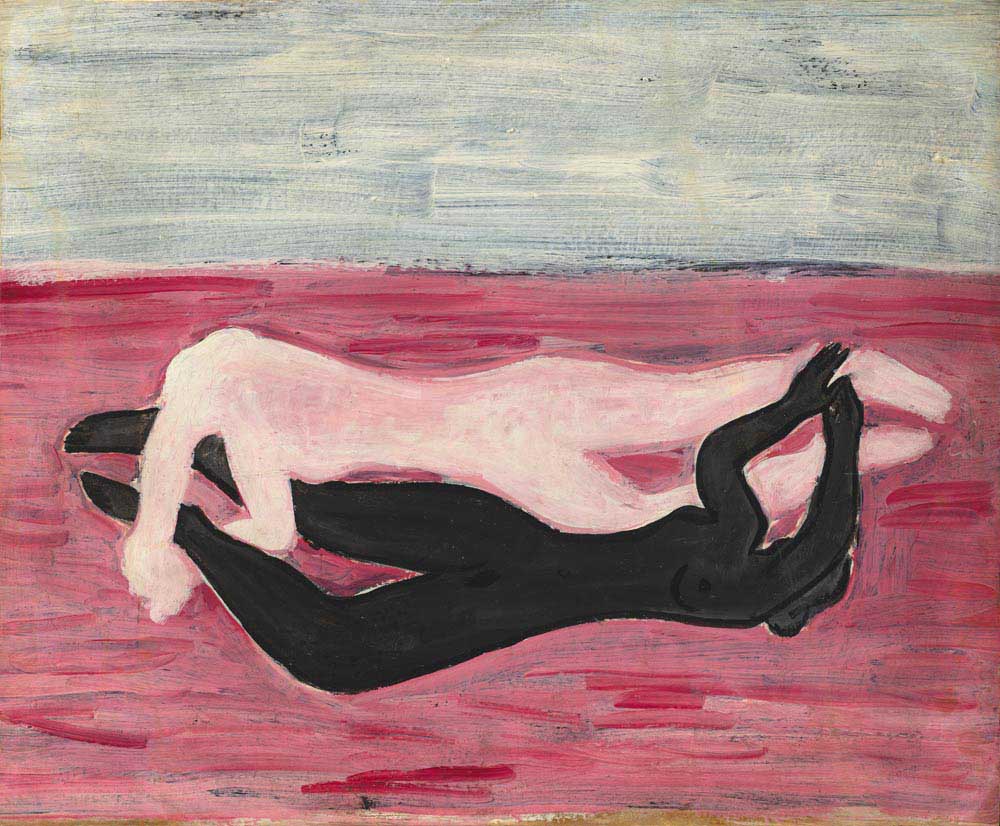
Black Nude, White Nude

Two bodies become reciprocal silhouettes

Two reclining figures overlap across a hot pink band. One is painted as a black silhouette, the other in pale pink and white. Their poses echo and reverse one another: bent arms, raised legs, and diagonal torsos form a compact system of counterweights.

The title names racial difference directly, reflecting the diverse model culture Sanyu encountered in Paris. Yet individualized features are withheld. The painting organizes contrast through color and contour, making the bodies both distinct presences and interlocking abstract shapes.

Look closely

  • Hands and feet creating small knots in the broad silhouettes
  • The figures overlapping without a clear front or back
  • Grey, pink, black, and white laid down as visible brushed bands
White Peonies in a Glass Vase by Sanyu, white blossoms emerging from dark leaves against a deep blue-black ground
Image reference: Li Ching Foundation Sanyu archive. Educational presentation.

07 / 1950s/1960s

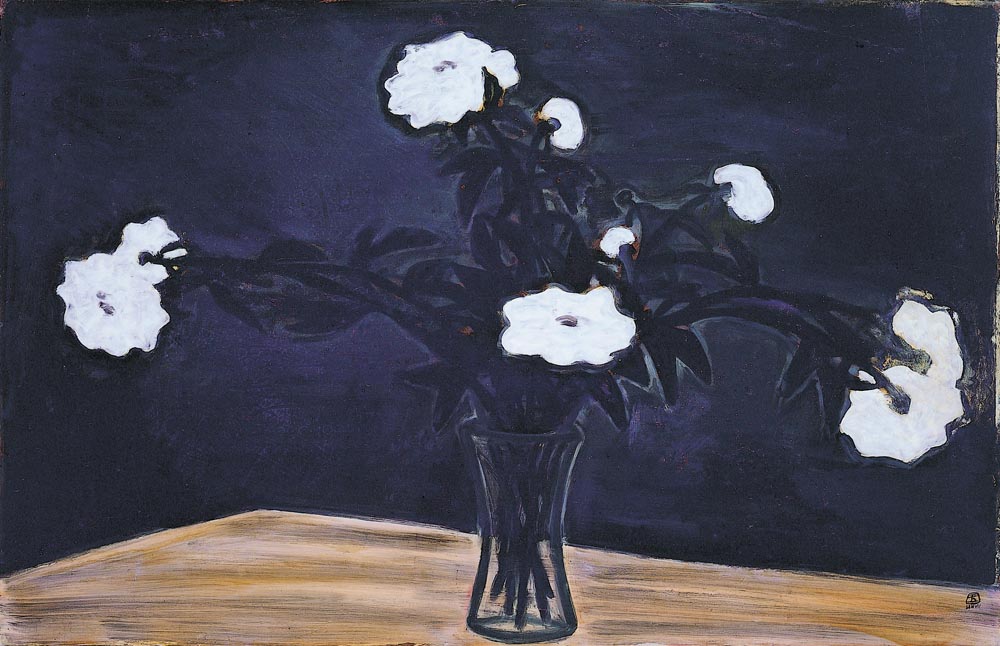
White Peonies in a Glass Vase

An auspicious flower becomes a nocturne

White peonies emerge at irregular intervals from a mass of leaves that nearly disappears into a blue-black field. A glass vase is described by a few dark lines, and the tabletop is a single ochre plane. The arrangement feels abundant and austere at once.

Peonies traditionally signal wealth and honor, but Sanyu drains the motif of ceremonial display. The late palette turns the still life into a meditation on visibility: blossoms flare briefly, leaves recede, and the transparent container seems barely able to hold them.

Look closely

  • White flowers appearing as separate islands of light
  • Leaves visible only through shifts within the dark ground
  • The vase defined more by interruption than by solid form
Four Nudes on a Gold Carpet by Sanyu, four outlined reclining figures stacked across a gold patterned field
Image reference: Li Ching Foundation Sanyu archive. Educational presentation.

08 / 1950s/1960s

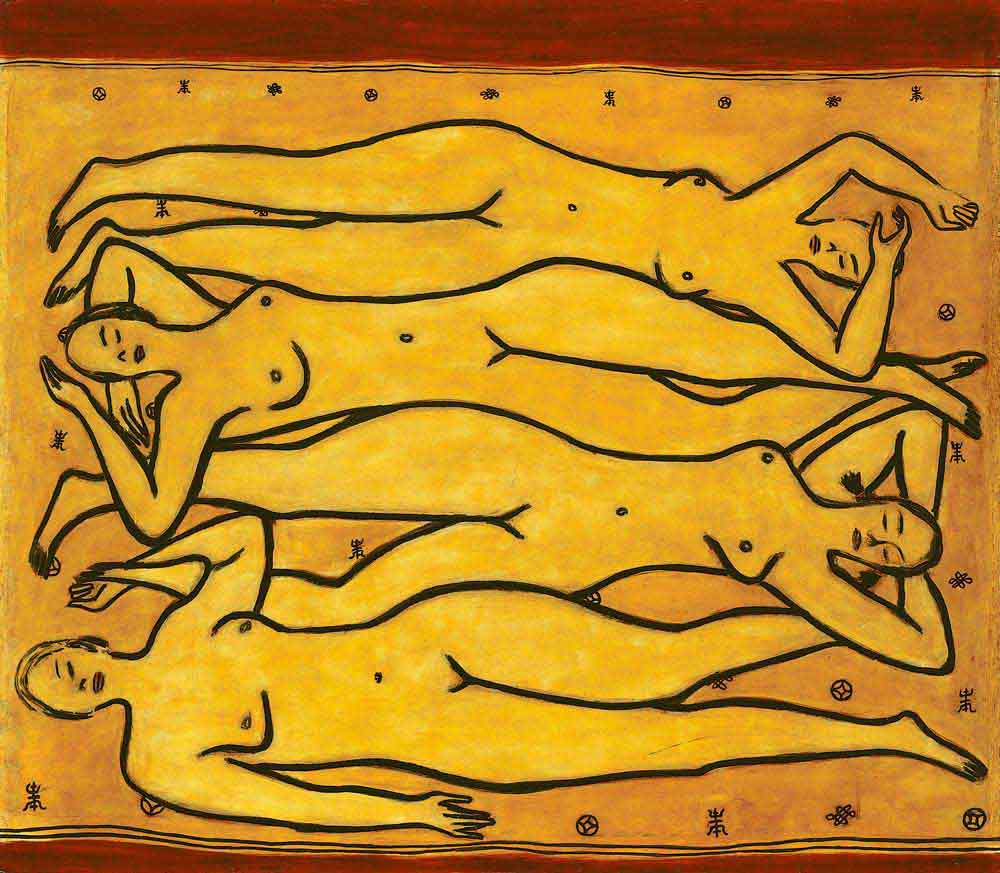
Four Nudes on a Gold Carpet

Calligraphic bodies fill a monumental carpet

Four reclining figures are stacked across a gold field, each enclosed by a heavy black contour. The bodies neither share a believable room nor recede behind one another. They are arranged like large characters across a textile, separated by small decorative emblems.

The painting brings Sanyu's decades of nude drawing to architectural scale. Anatomy is simplified but not careless: every bend of wrist, knee, and hip alters the rhythm of the whole surface. The National Museum of History has recognized the work as a significant antiquity in Taiwan.

Look closely

  • Four different poses held together by repeated horizontal curves
  • Carpet motifs occupying the same visual weight as facial features
  • Black outlines changing thickness like brush-written strokes
Rendezvous After Sunset by Sanyu, a solitary ochre nude seated against a pale ground beside a narrow yellow panel
Image reference: Li Ching Foundation Sanyu archive. Educational presentation.

09 / 1950s/1960s

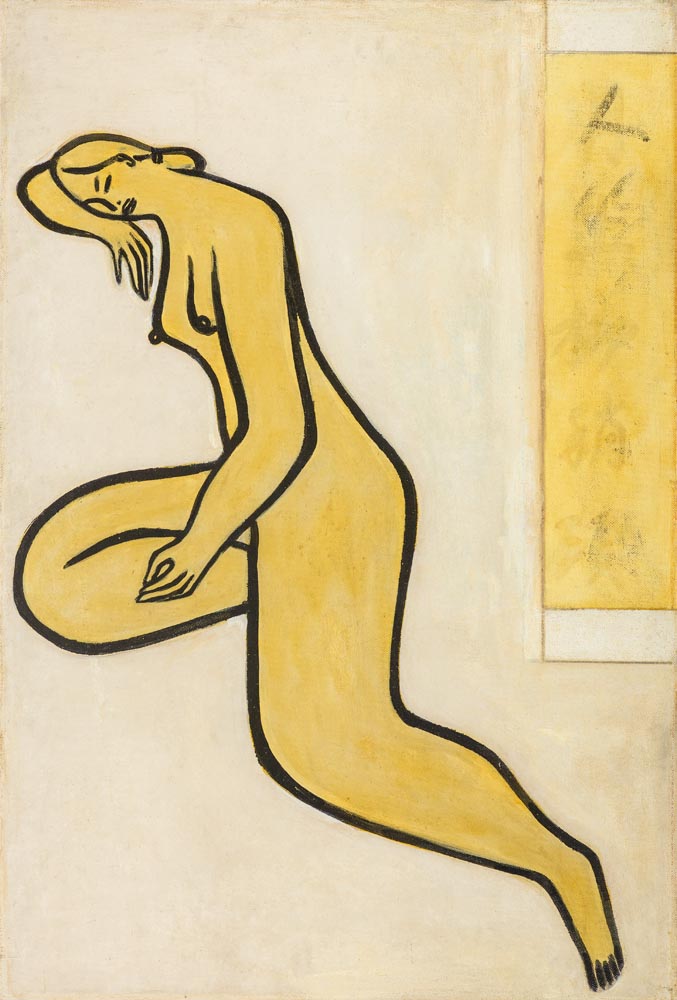
Rendezvous After Sunset

A promised meeting leaves one figure alone

The title suggests an encounter, but the picture contains a single seated nude. Her ochre body bends into an elongated loop against a pale, nearly empty ground. A narrow panel at right hints at a wall, window, or painting while refusing to establish a full interior.

The late work turns sensual contour toward solitude. The figure's head rests on one arm, her gaze closed or lowered. Sanyu makes the body read like one enormous written sign, then surrounds it with enough quiet space for absence to become the second subject.

Look closely

  • The arm, torso, and thigh forming one continuous circular movement
  • A right-hand panel that suggests a room without describing it
  • Empty ground functioning as emotional rather than unused space
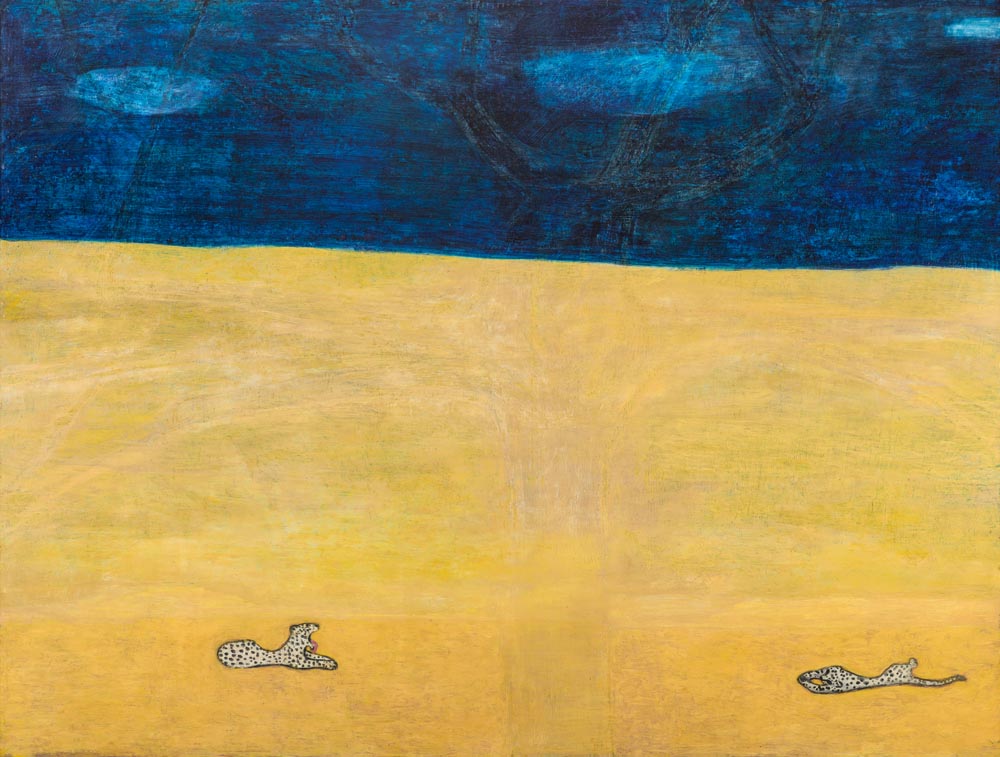
Leopards at Night by Sanyu, two tiny spotted leopards separated across a vast yellow plain beneath a deep blue sky
Image reference: Li Ching Foundation Sanyu archive. Educational presentation.

10 / 1950s/1960s

Leopards at Night

Two animals cross an immeasurable distance

Two leopards occupy a vast yellow plain under a deep blue-black sky. They are tiny, sharply outlined, and far apart. The scale of the landscape overwhelms narrative: whether the animals approach, flee, hunt, or simply endure cannot be resolved.

Sanyu's late animal paintings often replace the intimacy of the studio with exposed terrain. The simplified horizon and broad brushed fields look almost abstract, yet the spotted bodies keep the scene psychologically charged. Solitude becomes spatial fact.

Look closely

  • The enormous interval separating the two animals
  • Blue sky built from visible, repeatedly worked brushstrokes
  • Leopards rendered with miniature precision inside broad color fields

03 / Historical background

Sanyu's modernism was made between migration and survival.

Sanyu belongs to both interwar and postwar modernism. His career began inside Republican China's reform movements, took form in an immigrant Paris, survived depression and occupation, and ended while artistic power was shifting toward New York and abstraction.

That history changes how the paintings look. Their spare surfaces are not timeless elegance detached from circumstance. They record calligraphic training, inexpensive academies, lost patronage, material scarcity, friendship, racial difference, and the unstable routes through which a Chinese artist could become visible.

01

1895-1919

From late Qing reform to May Fourth

Sanyu's childhood overlapped with industrial growth, the fall of the Qing dynasty, and urgent debate about how China could modernize. Family wealth from silk production funded private education, while calligraphy still formed a living discipline rather than a heritage quotation. By 1919, May Fourth protests linked cultural reform, national sovereignty, and study abroad.
02

1919-1925

Chinese students build routes to France

The Diligent Work-Frugal Study movement brought thousands of Chinese students and workers to France. Not all followed the same program or politics, but the route created durable networks among artists, writers, and future political leaders. Paris and Berlin became connected nodes in a Chinese debate about art education, science, social reform, and cultural independence.
03

1920s

The School of Paris was an immigrant world

The Ecole de Paris was not a single style or institution. It described a crowded artistic ecology shaped by migrants from Eastern Europe, Asia, Africa, and the Americas, alongside French artists, dealers, academies, salons, and cafes. The Grande Chaumiere offered inexpensive life drawing outside official academic hierarchy, though access to recognition remained unequal.
04

1929-1939

Modernism depended on patrons and fragile markets

The crash and depression exposed how strongly artistic survival depended on private dealers, family money, salon access, and social networks. For a Chinese artist without institutional employment, the loss of one patron could determine what materials were affordable and whether work remained visible. Sanyu's compressed surfaces and unconventional supports belong to this material history as much as to style.
05

1939-1945

Occupation narrows a foreign artist's world

War and German occupation transformed Paris. Foreign artists faced surveillance, displacement, scarcity, and collapsing markets. Sanyu stayed, exhibited when possible, wrote, and made small sculptures when painting materials were beyond reach. The apparent simplicity of his wartime and immediate postwar images cannot be separated from those constraints.
06

1945-1950

Postwar centers shift between Paris and New York

After 1945 Paris tried to recover its international position while New York's galleries, museums, photographers, and abstract painters gained influence. Sanyu's New York stay connected him not to triumphalist Abstract Expressionism but to Robert Frank, migration, failed sales, and a group of paintings preserved through friendship rather than museum acquisition.
07

1950-1966

Figuration persists beside abstraction

Postwar modernism is often narrated as abstraction's victory. Sanyu complicates that account. He kept painting flowers, nudes, fish, and animals while making color fields flatter, emptier, and psychologically charged. His work shows that figuration could absorb calligraphic action and the spatial lessons of abstraction without abandoning recognizable bodies.
08

After 1966

Cold War routes reshape the archive

Sanyu's posthumous record was assembled across Paris, New York, Taipei, and later Hong Kong. The National Museum of History collection grew from paintings sent for an exhibition that never occurred; Robert Frank's group survived through personal loyalty; later conservation and catalogue work made dispersed evidence legible. Recognition followed the routes of the diaspora rather than a single national canon.

04 / The wider study room

Sanyu inside a larger constellation of modern Chinese lives.

Comparison reveals choices: who returned, who stayed, who taught, who found galleries, and how each artist made line and oil answer to a different history.

01Zao Wou-Ki 赵无极

1920-2013

Lyrical abstraction built from landscape, calligraphy, memory, and monumental space.

Zao arrived in Paris a generation after Sanyu and achieved the sustained gallery and museum career that eluded him. Reading them together reveals two very different ways Chinese brush culture entered modern European painting.

Open the full artist study
02Wu Guanzhong 吴冠中

1919-2010

Landscape modernism negotiated through oil, ink, political pressure, and return.

Wu studied in Paris after the Second World War and returned to China in 1950. His career shows how different the stakes of formal experiment became inside the People's Republic.

Open the full artist study
03Chu Teh-Chun 朱德群

1920-2014

Luminous abstraction shaped by calligraphic force, weather, music, and deep space.

Chu settled in Paris in 1955 and, like Zao, developed a large-scale abstract language. His institutional path contrasts with Sanyu's continuing attachment to intimate figuration and marginal materials.

Open the full artist study
04Pan Yuliang 潘玉良

1895-1977

A pioneering woman artist who made the body a question of authorship and modern freedom.

Pan's nudes offer a vital counterpoint to Sanyu's. She studied and taught across China and Europe, then lived in Paris from 1937 while navigating gender, race, academic training, and self-representation.

Open the full artist study
05Lin Fengmian 林风眠

1900-1991

The France-trained artist-educator who rebuilt figure, landscape, and opera within the square sheet.

Lin returned to China and founded the Hangzhou academy that shaped Zao, Chu, and Wu. His institutional career and private Shanghai paintings contrast with Sanyu's long life outside the academy in Paris.

Open the full artist study

05 / Sources

Continue with the archives and museums behind the record.

Biography, dates, dimensions, catalogue numbers, and collection histories are drawn primarily from the Li Ching Foundation's Sanyu archive, with museum records from Paris and Taipei.