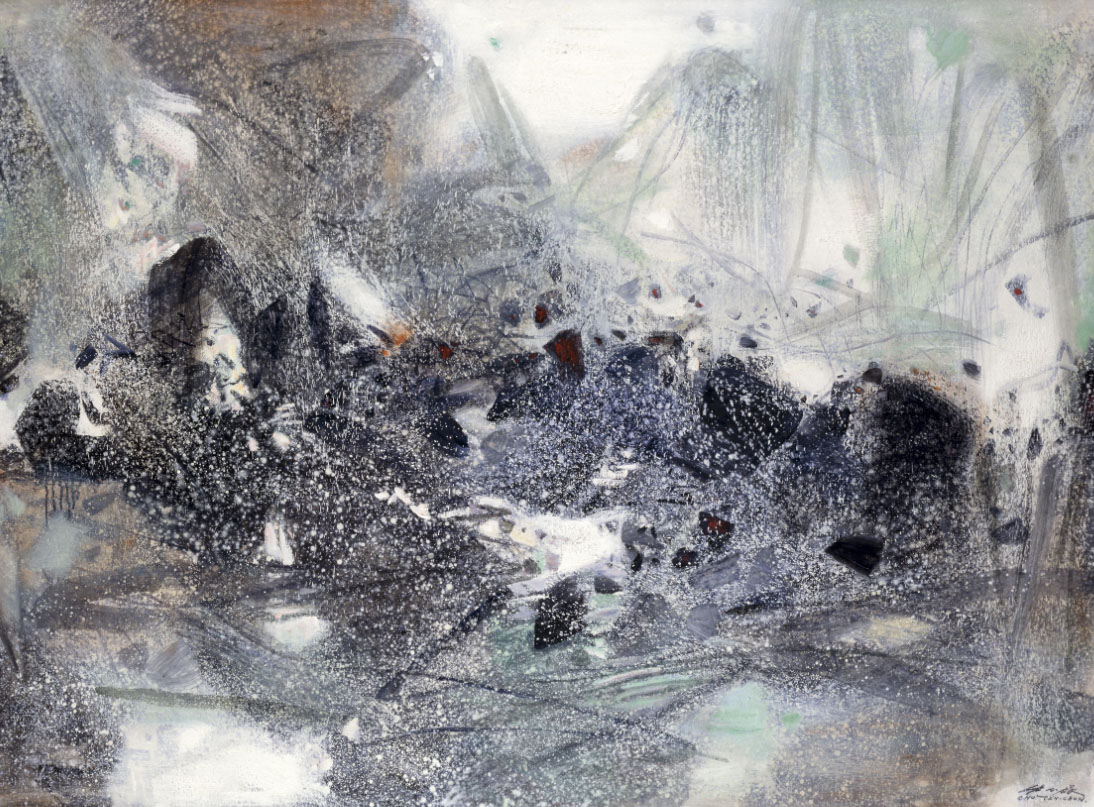
Chu did not abandon landscape when he became abstract; he relocated its weather, force, and spatial rhythm inside paint.
1920-1937
A calligraphic childhood and an avant-garde academy
Chu Teh-Chun was born in Baitu in northern Jiangsu, an area now administered as Anhui. His father and grandfather were traditional physicians and collectors of Chinese painting, and a tutor introduced the three sons to calligraphy and classical poetry. At fifteen Chu entered the Hangzhou Academy of Fine Arts under Lin Fengmian. The school placed drawing, oil painting, Chinese painting, and modern European art in active conversation. Chu studied ink with Pan Tianshou, learned Western techniques from teachers shaped by Paris and Dijon, and met Wu Guanzhong in 1936. Chu helped Wu prepare for the academy entrance examination, beginning a friendship that would outlast war, separation, and radically different careers.1937-1948
The academy migrates, and landscape becomes lived geography
Japanese invasion forced the academy to leave Hangzhou in November 1937. Chu traveled with teachers and students through Zhejiang, Jiangxi, Hunan, Yunnan, and Sichuan before reaching wartime Chongqing. He sketched people and terrain along the route, graduated in 1941, and joined the faculty. He later taught architectural drawing at National Central University. A 1947 journey down the Yangtze impressed him with the river's immense spatial drama, though paintings entrusted to a friend or carried on the boat were lost. Returning home in 1948, he learned that his father and a brother had died during the war. These years made landscape inseparable from movement, loss, and memory rather than an inherited pictorial category alone.1949-1955
Taipei, teaching, and a sold-out departure
Chu and his first wife, Liu Hanfu, left Nanjing for Taipei at the end of 1949. He taught drawing in architecture and fine-art departments, worked alongside painters debating modern abstraction in Taiwan, and continued to make figurative oils of mountains, still lifes, and nudes. His first solo exhibition at Taipei's Sun Yat-sen Hall in 1954 sold out. The proceeds paid for passage to France and supported his first Paris years. When he sailed in March 1955, his move belonged to the same transnational history that had carried Sanyu, Pan Yuliang, Lin Fengmian, and Zao Wou-Ki to Europe, but it occurred after war had divided their generation into new political and geographic conditions.1955-1978
Paris loosens the figure and calligraphy enters abstraction
Chu arrived in Marseille in May 1955 and settled in a small room on rue Lhomond. He drew at the Grande Chaumiere, reconnected with Zao Wou-Ki, and met Paris-based Chinese artists including Sanyu and Pan Yuliang. Encounters with Goya, El Greco, and especially Nicolas de Stael helped him move beyond descriptive figuration in 1956. Galerie Legendre offered him an exclusive contract in 1958 and presented his first all-abstract solo exhibition. Broad masses soon gave way to quicker signs, layered darkness, and eruptive color. Around 1971 he resumed daily calligraphy, not as an ornamental quotation but as a discipline of pressure, speed, suspension, and breath that could reorganize the entire painted field.1978-1997
Recognition, return to China, and snow as an event of light
A 1978 retrospective in Saint-Etienne marked widening institutional recognition; Chu became a French citizen in 1981. In 1983 he returned to China for the first time in thirty-five years, reunited with family and former colleagues, and visited the Yellow Mountains. The journey refreshed landscapes long held in memory and renewed his wash drawings. Two years later, a sudden snowstorm seen while traveling back from Geneva initiated the celebrated winter paintings. White was no longer blankness or surface highlight. It became suspended weather, a moving veil that opened depth among dark strokes and incandescent color. Larger studios allowed increasingly monumental canvases, culminating in his 1997 election to the Academie des Beaux-Arts as its first member of Chinese origin.1997-2014 and after