Lin Fengmian's Landscape, an oil painting of mountain, water, trees, and houses

Lin Fengmian / 林风眠

Lin Fengmian

The painter and educator who made the square sheet a meeting place for color, ink, opera, folk form, and European modernism.

Begin the life story
01

Landscape1940s

1900-1991Meixian / Dijon / Paris / Hangzhou / Shanghai / Hong KongOil / Ink and color / Essay / Art educationSquare composition / opera / landscape / figure

01 / Biography

A modernist life spent building schools, losing worlds, and inventing a private pictorial language.

Lin transformed Chinese art not only through his own paintings but through institutions, teaching, and a belief that comparison could be creative rather than imitative.

Lin's synthesis was never a decorative mixture: it was a way to rebuild pictorial form after personal grief, war, institutional conflict, and political violence.

1900-1919

A stonecarver's village, early painting, and lasting loss

Lin Fengmian was born in Gegongling Village in Meixian, Guangdong, into a Hakka family of stonecarvers. His grandfather carved gravestones, and his father wrote their inscriptions, painted, and introduced the boy to the Mustard Seed Garden Manual. Lin's mother was sold away from the family when he was seven, a separation that remained one of the deepest wounds of his life. He painted from childhood, but his departure for Europe emerged from the wider work-study movement that linked education to national renewal after the fall of the Qing dynasty. In 1919 he raised funds in Shanghai and sailed for France in a fourth-class berth with other young Chinese students.

1919-1925

Dijon, Paris, Berlin, and the discovery of expressive modernism

Lin reached Marseille in January 1920, learned French while working, and entered the Ecole des Beaux-Arts in Dijon. Its director recognized his ability and recommended him to Fernand Cormon's studio at the Paris Beaux-Arts. Academic training gave Lin command of drawing, but museums, salons, and travel made a more decisive impact. He absorbed Impressionism, Fauvism, post-Impressionism, and German expressionist intensity during a year in Berlin. His paintings appeared in the Salon d'Automne, and forty-two works entered the 1924 Strasbourg exhibition of Chinese art. That year his first wife, Elise von Roda, died shortly after childbirth, and their infant son soon followed. Personal grief, exposure to modernist form, and the problem of cultural renewal converged before his return to China.

1926-1937

Beijing controversy and the founding of Hangzhou's modern academy

Back in China, Lin became director of the National Beijing Fine Art School in 1926. He expanded music and drama, hired Qi Baishi despite opposition, introduced nude drawing, and organized a major Beijing Art Assembly. Conservative and political resistance removed him from office in 1927. Supported by the educational reformer Cai Yuanpei, Lin then founded the National Academy of Art in Hangzhou in 1928 and served as its first president. The school placed Chinese and Western painting, design, music, and modern pedagogy together under a principle of academic openness. Its students included Zao Wou-Ki, Chu Teh-Chun, Wu Guanzhong, Li Keran, and many artists who would define several different modernisms. Lin's achievement was institutional as much as stylistic: he made comparison part of everyday artistic training.

1937-1952

War, resignation, Chongqing solitude, and the move to Shanghai

After Japanese invasion in 1937, Lin led more than two hundred academy teachers and students out of Hangzhou with books and teaching materials. The school merged with the Beiping college, but administrative conflict forced his resignation in 1938. His home was ransacked and paintings destroyed. Lin moved through Shanghai and Hong Kong before reaching wartime Chongqing in disguise, where he lived simply and painted for years. He briefly returned to teaching after the war but was repeatedly dismissed and reinstated as political systems changed. In 1951 he left the academy and settled in Shanghai. There, in a semi-reclusive life supported by small sales and occasional students, he concentrated on painting and discovered in Chinese opera a visual language of compressed time, layered action, angular costume, and shadow-puppet silhouette.

1952-1977

The square format, precarious survival, destruction, and prison

In Shanghai Lin developed the square compositions now most closely associated with him. Landscapes, women, flowers, birds, and opera figures combine translucent ink, opaque color, backlighting, folk forms, and modernist geometry. The square rejected both the conventional hanging scroll and a window-like European perspective, creating a concentrated field where several spatial systems could coexist. Political campaigns repeatedly narrowed his life. He was sent to labor in 1958 and criticized for an Impressionist publication. During the Cultural Revolution he soaked and pulped many paintings to prevent them from being used as evidence against friends. Arrested in 1968 on fabricated espionage charges, he endured torture and four years in detention. Released at the end of 1972, he resumed work under continuing surveillance and criticism.

1977-1991 and after

Hong Kong, late abundance, retrospectives, and an educational legacy

Lin received permission to leave Shanghai in 1977 and reached Hong Kong carrying only dozens of paintings, one hundred blank sheets of paper, and a few belongings. He visited his family in Brazil but returned to Hong Kong, where his late years became remarkably productive. A 1979 exhibition at the Musee Cernuschi in Paris reconnected him with France and former students; major exhibitions followed in Tokyo, Taipei, Beijing, and elsewhere. He continued painting almost daily until the final months before his death from complications of pneumonia in 1991. Many early works had been lost to war, poverty, deliberate destruction, and political seizure, so the surviving career is radically uneven. Yet his square-format paintings and the generations trained by his academies made Lin one of the central architects of twentieth-century Chinese modernism.

02 / Selected works

Ten works across oil, opera, flowers, figures, birds, and autumn.

Follow Lin from transitional oil painting into the square sheet, where backlight, Chinese ink, Fauvist color, Cubist layering, opera movement, and folk silhouette become one flexible language.

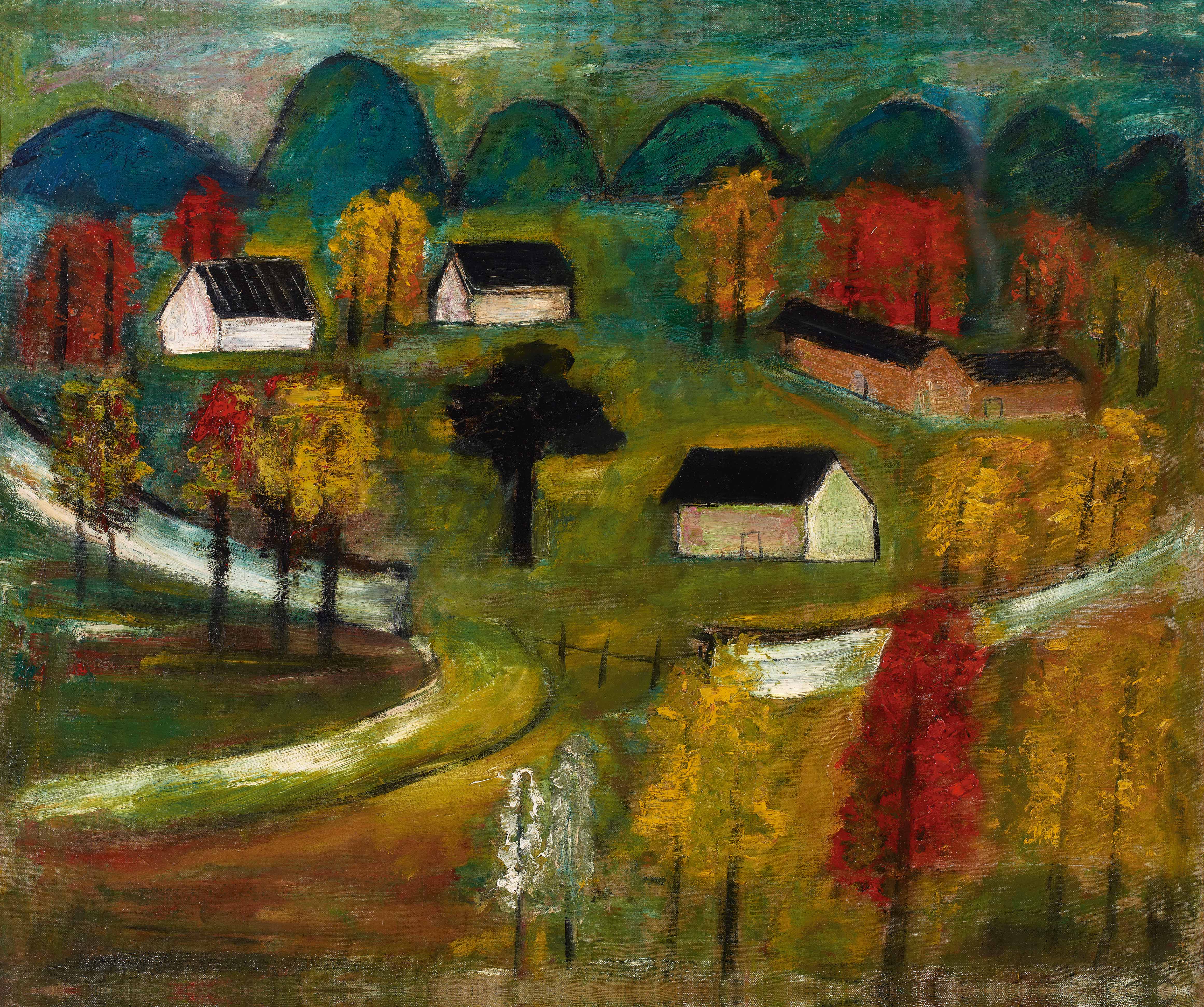
Lin Fengmian's Landscape, an oil painting of mountain, water, trees, and houses
Image reference: Taikang Art Museum. Educational presentation.

01 / 1940s

Landscape

Oil begins to think in the compact space of ink landscape

This wartime or immediate postwar landscape belongs to the transition between Lin's early expressionist oils and his mature ink-and-color paintings. Mountain, river, village, and trees remain recognizable, but they are compressed into a near-square field whose warm and cool areas carry the construction.

Although painted in oil, the work avoids heavy modelling. Distant mountains and pale water are treated as intervals, while black trees provide a calligraphic center. Lin is not making European oil imitate an old Chinese scroll; he is testing how oil can support mobile viewpoints and a concentrated poetic space.

Look closely

  • Dark trees acting as the structural hinge
  • White houses punctuating the middle distance
  • Warm foliage crossing a cool mountain-and-water field
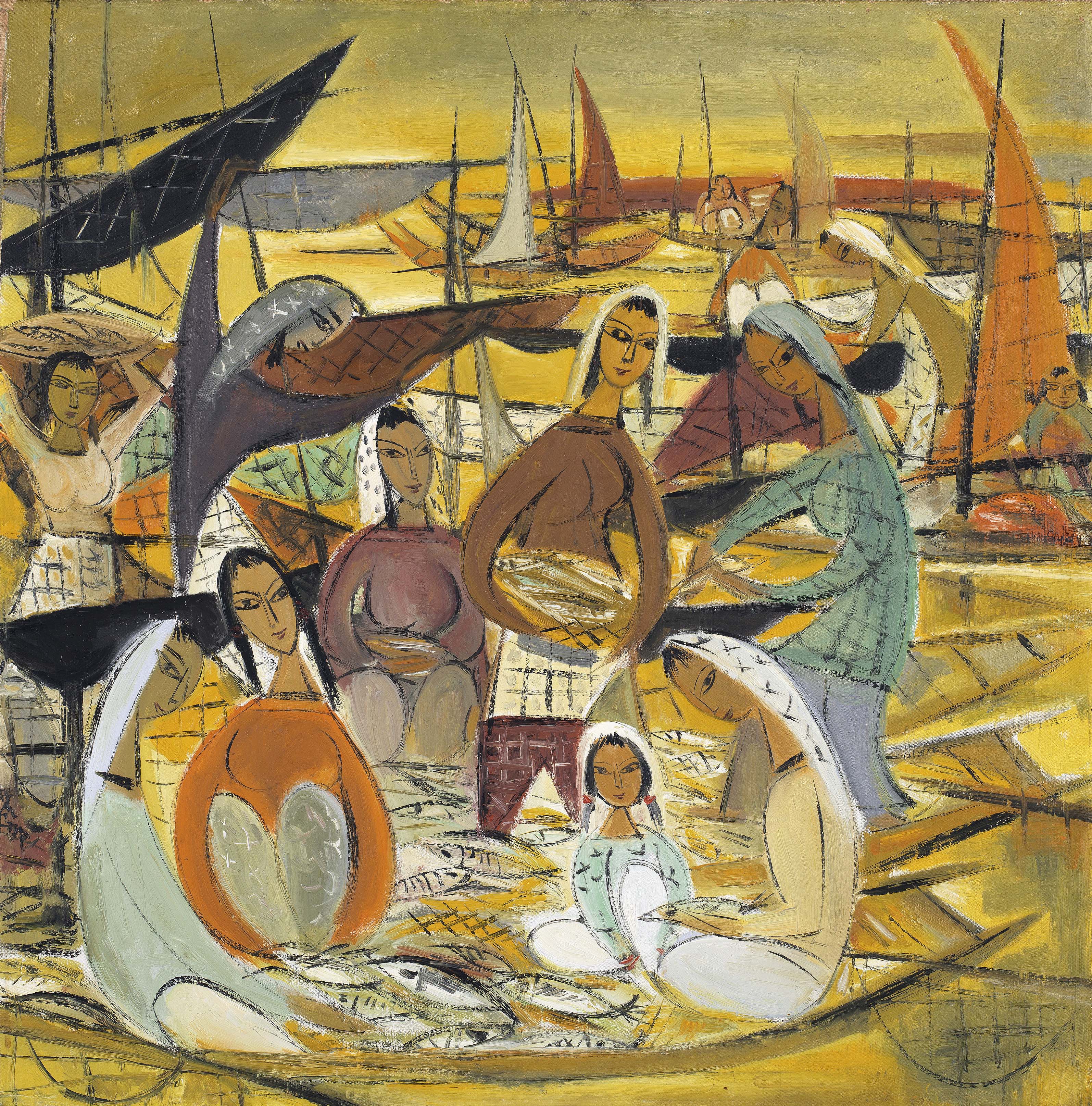
Lin Fengmian's Fishing Village, an oil painting of fisherwomen, baskets, and boats
Image reference: Christie's catalogue. Educational presentation.

02 / c. 1950s-1960s

Fishing Village

Labor, boats, and backlight become an architecture of color

Women gather around baskets of fish while boats and masts rise behind them. The subject came from Lin's rural and coastal sketching trips, but observed life is reorganized into overlapping silhouettes and color blocks. The nearly square canvas keeps foreground labor and distant harbor in one compressed rhythm.

Backlighting gives the figures a halo-like edge without dissolving their physical work. European lessons in light and Cubist structure meet Chinese ideas of multiple viewpoint and the decorative force of contour. The result honors ordinary activity without submitting it to a single academic realism.

Look closely

  • Circular gathering of figures around the baskets
  • Masts turning the harbor into a linear grid
  • Golden backlight joining bodies, boats, and water
Lin Fengmian's Cormorants, an ink-and-color painting of dark water birds
Image reference: Sotheby's catalogue. Educational presentation.

03 / c. 1950s

Cormorants

Birds gather as silhouettes, memory, and social rhythm

Cormorants cluster within a square composition whose washes suggest water and mist without constructing a conventional vista. Their bodies are made by quick dark strokes, each distinct yet held within a collective pulse. The motif connected Lin to childhood memories of forest and water as well as to the fishing landscapes he studied around Shanghai.

The painting's economy is not emptiness. Subtle blue-grey wash, reeds, and the intervals between birds create a dense emotional atmosphere. Lin lets calligraphic speed describe weight and posture while preserving the innocence and companionship he associated with birds.

Look closely

  • Each bird tilted at a slightly different angle
  • Pale wash carrying atmosphere without a horizon
  • Dark bodies balanced by unpainted paper
Lin Fengmian's Lotus Lantern, an ink-and-color image of geometric Chinese opera figures
Image reference: Sotheby's catalogue. Educational presentation.

04 / 1956

Lotus Lantern

Opera compresses time into overlapping masks and robes

Lin was fascinated by how opera allows successive actions and identities to occupy one stage. In Lotus Lantern, figures overlap within a square field, their costumes broken into angular planes and sweeping curves. Narrative remains present, but time is compressed into a simultaneous visual event.

Cubist layering is one resource among several. Paper-cut silhouettes, shadow puppetry, painted opera masks, and calligraphic line are equally important. Lin's synthesis is convincing because these sources share a concern with contour, transformation, and staged movement rather than merely resembling one another.

Look closely

  • Faces functioning as masks inside larger geometric bodies
  • Red, black, gold, and blue establishing dramatic contrast
  • Robes moving between straight architecture and fluid line
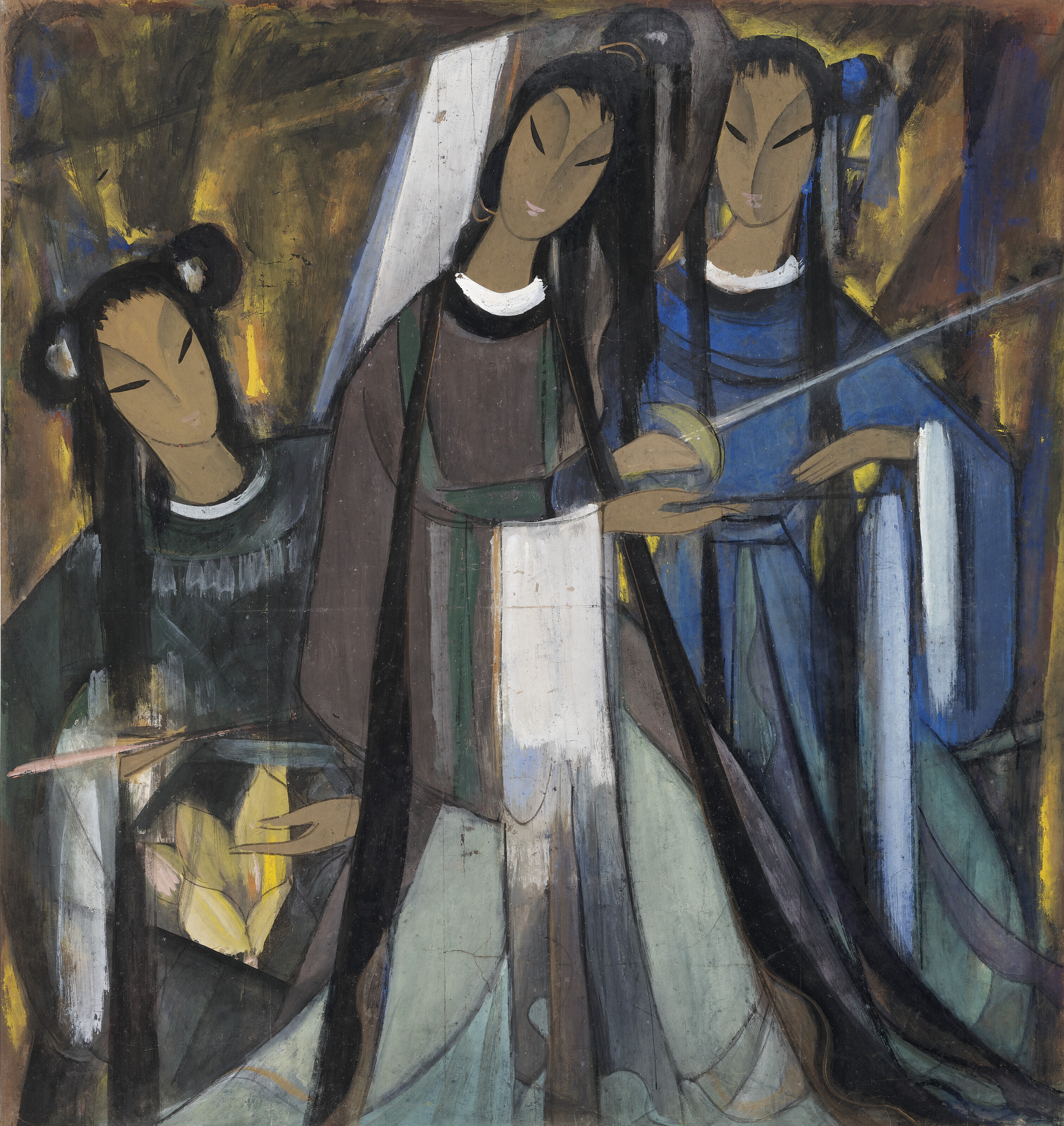
Lin Fengmian's Opera Figures, an ink-and-color painting of three stylized performers and a lotus lantern
Image reference: Christie's catalogue. Educational presentation.

05 / 20th century

Opera Figures

Backlight turns three performers into a layered modern tableau

Three opera figures lean in opposing directions around the glow of a lotus-shaped lantern. Their masks and costumes are compressed into angular planes and sweeping lines, while warm light appears from behind them. Lin converts stage action into a layered tableau without stripping away its dramatic identity.

The opaque gouache-like color recalls the mass of Cubist oil painting, but shadow puppetry, paper cutting, opera posture, and the dim bulb in Lin's Shanghai studio are equally important. The image is modern because these visual systems are made to act together, not because one has been disguised as another.

Look closely

  • Two front figures leaning right against a rear figure leaning left
  • Orange-yellow light flickering behind the dark costumes
  • The lotus lantern anchoring an otherwise unstable stage space
Lin Fengmian's Gladioli, a vibrant ink-and-color flower painting
Image reference: The Metropolitan Museum of Art. Educational presentation.

06 / 1960s

Gladioli

Flowers erupt beyond domestic still life

The gladioli rise through translucent washes and thrusting dark leaves. Fauvist color is an obvious comparison, but Lin's brush also depends on the boneless flower tradition, in which petals are built without enclosing outlines, and on calligraphic discipline in the leaves.

The image is energetic rather than decorative. Blossoms press against the sheet, reds and purples shifting in density while the leaves cut upward. Lin makes flower painting capable of bodily force, turning a familiar subject into an event of growth and pressure.

Look closely

  • Petals formed by pooled wash rather than contour
  • Leaves accelerating upward in dark strokes
  • Color intensifying toward the crowded center
Lin Fengmian's early 1960s Seated Woman in ink and color
Image reference: The Metropolitan Museum of Art. Educational presentation.

07 / early 1960s

Seated Woman

The modern figure is built from contour, pattern, and pause

The seated woman occupies a shallow interior, her body defined by economical line and broad patterned areas rather than anatomical modelling. Lin's knowledge of Matisse is visible, yet the figure's restraint also depends on Chinese contour and the active role of untouched paper.

She is neither an academic study nor a narrative heroine. Pose, clothing, furniture, and interval create a quiet psychological field. Lin allows decorative pattern to carry structure, preventing the figure from being separated from the space she inhabits.

Look closely

  • Long contour describing the body with very few corrections
  • Pattern working as volume rather than surface ornament
  • Empty paper stabilizing the compact pose
Lin Fengmian's Two Nuns, a vertical ink-and-color painting of two standing figures
Image reference: The Metropolitan Museum of Art. Educational presentation.

08 / 20th century

Two Nuns

Two vertical figures turn empty space into a third presence

Two Nuns uses a tall hanging-scroll format rather than Lin's usual square. The paired figures are simplified into dark robes, pale faces, and restrained contour. Their proximity creates intimacy, while the open paper around them gives silence a palpable form.

The Met connects the work to Matisse's economy and pattern, but Lin's use of empty space comes from a different visual inheritance as well. The painting's strength lies in this double knowledge: modern simplification and Chinese reserve meet without becoming a checklist of influences.

Look closely

  • Small shifts in head and shoulder preventing strict symmetry
  • Dark robes anchoring an otherwise pale sheet
  • The interval between figures acting as active form
Lin Fengmian's late 1970s Seated Woman in ink and color
Image reference: The Metropolitan Museum of Art. Educational presentation.

09 / late 1970s

Seated Woman

After prison and departure, the seated figure is remade from memory

This late seated woman belongs to the period around Lin's move to Hong Kong. The square field, abbreviated interior, and controlled color return to a familiar subject after years of persecution and the destruction of many earlier paintings. Repetition here is not stagnation; it is recovery through reconstruction.

The body remains calm, but line and wash never become inert. Dark contour thickens and thins, colors meet without fully closing, and the surrounding paper keeps the figure open to air. Lin's mature economy comes from decades of testing what can be removed without losing presence.

Look closely

  • Contour varying in pressure around the body
  • Color areas stopping short of complete enclosure
  • A square format that makes the pose feel concentrated
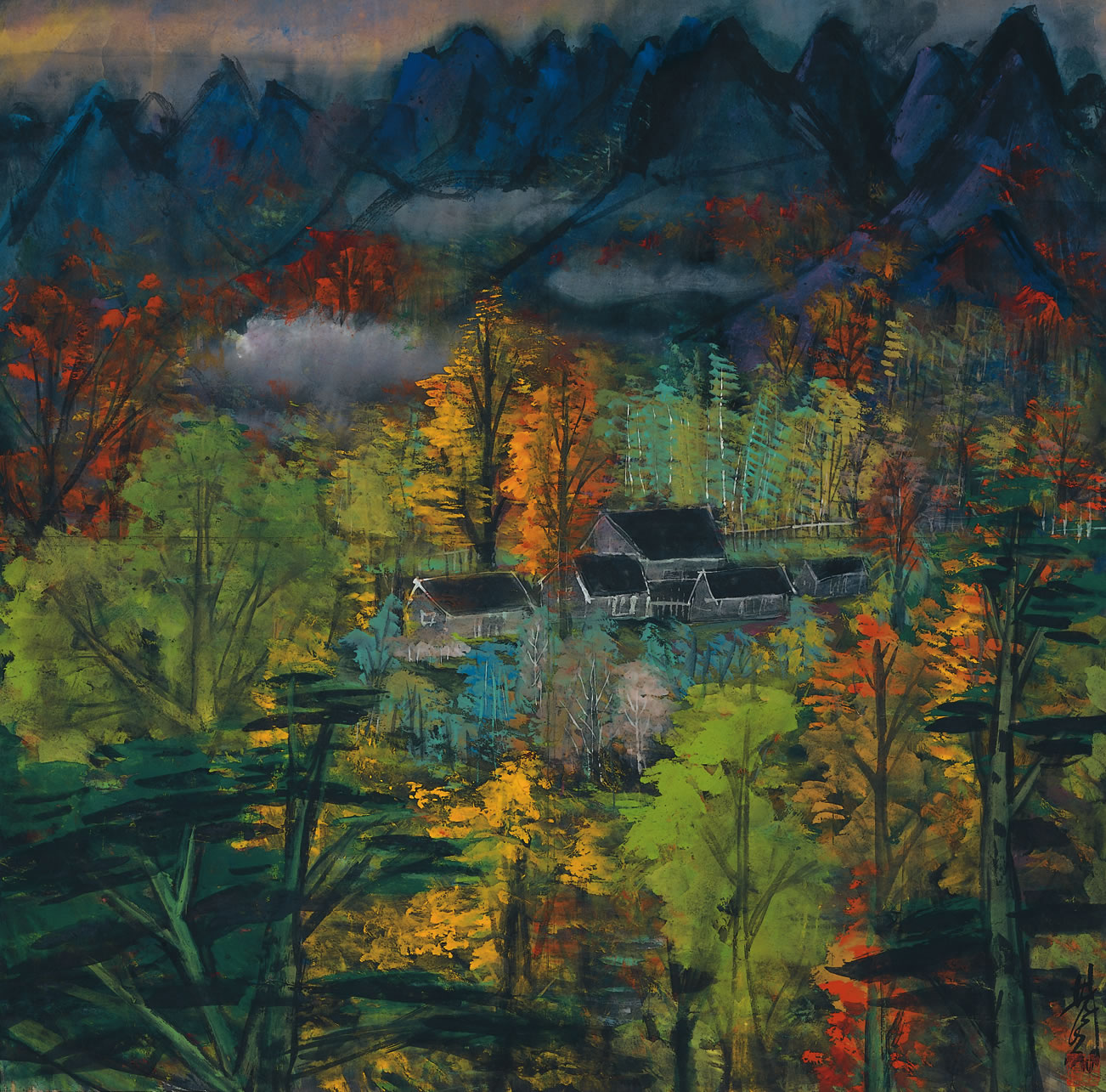
Lin Fengmian's Autumn Landscape, a square ink-and-color view of dark woods and houses
Image reference: Hong Kong Museum of Art. Educational presentation.

10 / 1977-1978

Autumn Landscape

A late autumn landscape abandons detail without losing home

Painted after Lin settled in Hong Kong, Autumn Landscape returns to an idea first prompted by Tianping Mountain in 1953. A dark wash establishes the backlit woods, while ochre foliage, peacock blue, mauve, and pale houses punctuate the square. Color is made brightest by emerging from darkness.

Compared with his earlier landscapes, forms are freer and more abbreviated. The homestead remains, but careful description gives way to splashed and dotted rhythm. The painting demonstrates why Lin's late period was not simply a coda: exile and age released a new directness inside structures he had developed over decades.

Look closely

  • Black wash functioning as both forest and backlight
  • Ochre dots suspended across the dark field
  • Small pale roofs holding human scale within abstraction

03 / Historical background

Lin's modernism was built through education, war, political rupture, and the survival of private form.

Lin's career runs through the work-study movement, the May Fourth era, Republican institution-building, Japanese invasion, civil war, socialist cultural policy, the Cultural Revolution, and late Hong Kong. He was never merely an individual stylist moving between traditions; he created and lost institutions inside a century of repeated upheaval.

The square-format paintings often look intimate and timeless, but their economy is historical. They were produced after grand early oils disappeared, after administrative conflict ended his academy leadership, and under material and political pressure in Shanghai. Their apparent quiet is a hard-won form of independence.

01

1919-1925

The work-study movement sends a generation to Europe

Chinese students traveled to France to combine labor, language, and modern education. Lin entered academies and salons but also encountered a plural Europe of museums, modernist movements, and political reconstruction after the First World War.
02

1926-1937

Art education becomes a project of national renewal

Cai Yuanpei and reformist educators treated art as central to public culture. Lin's Beijing and Hangzhou schools expanded curricula, defended nude study, employed both ink and oil painters, and trained artists to compare systems rather than obey a single orthodoxy.
03

1937-1945

Japanese invasion displaces academies and destroys work

Schools moved inland with books, teachers, and students. Lin lost his home, leadership, and paintings, then worked in wartime Chongqing. Modernist education survived, but continuity came at the cost of profound institutional and personal rupture.
04

1949-1957

The new People's Republic reorganizes artistic authority

Academies were remade around socialist cultural priorities, and formal experimentation became politically vulnerable. Lin left teaching, moved to Shanghai, and developed a private practice whose modest square sheets could circulate through personal and diplomatic networks.
05

1950s-1965

Opera and folk form offer another route to modernism

Chinese opera, paper cutting, ceramic decoration, and shadow puppetry gave Lin models of stylized movement and simultaneous time. These were not static traditions opposed to Europe; they were dynamic visual systems through which Cubist and expressionist lessons could be rethought.
06

1966-1976

The Cultural Revolution attacks people, archives, and objects

Lin destroyed paintings to protect himself and others, was denounced, tortured, and imprisoned for four years. The loss reshaped the surviving record. Any account of his style must also account for work that can no longer be seen and for the conditions under which he resumed painting.
07

1977-1991

Hong Kong enables late work and international reconnection

After leaving Shanghai, Lin used Hong Kong as a base for painting, family travel, and exhibitions in Paris, Tokyo, Taipei, and Beijing. The late sheets are freer and more prolific, while retrospectives restored his educational role to public history.
08

After 1991

Museums reconstruct an uneven archive

Collections in Hong Kong, Shanghai, New York, Beijing, and elsewhere preserve different fragments of Lin's career. Chronologies and exhibitions must bridge lost early oils, surviving Shanghai works, personal archives, and a large late production without pretending the record is complete.

04 / The wider study room

A teacher's influence becomes visible through difference.

Lin's students and contemporaries did not inherit one style. They carried his permission to compare, transform, leave, return, and argue into radically different modernisms.

01Zao Wou-Ki 赵无极

1920-2013

A Hangzhou student who transformed landscape memory into internationally scaled abstraction.

Zao studied inside the comparative curriculum Lin built, then remained in Paris after 1948. His expansive oils show one global route opened by Lin's insistence that modern form could be culturally multiple.

Open the full artist study
02Sanyu 常玉

1895-1966

A Paris contemporary whose line joined calligraphy to the modern nude and still life.

Sanyu belonged to the earlier work-study generation in France. Unlike Lin, he did not return to build institutions. Their careers expose two very different consequences of Chinese modernism's encounter with Paris.

Open the full artist study
03Wu Guanzhong 吴冠中

1919-2010

A student who brought Paris modernism back to landscape, oil, ink, and public debate.

Wu repeatedly honored Lin as the teacher who made intellectual freedom possible. His return to China and later defense of formal beauty extend Lin's educational project through a different political generation.

Open the full artist study
04Chu Teh-Chun 朱德群

1920-2014

A Hangzhou student whose calligraphic abstraction turned landscape into light and weather.

Chu carried Lin's dual training from wartime China to Taiwan and Paris. Their 1979 reunion joined a teacher whose works had been destroyed to a former student gaining international recognition.

Open the full artist study
05Pan Yuliang 潘玉良

1895-1977

A pioneering painter and sculptor who made the modern body central to transnational Chinese art.

Pan and Lin both trained in France, taught after returning, and challenged conservative ideas about the body. Pan's gendered reception and long Paris exile reveal pressures different from Lin's institutional authority and later persecution.

Open the full artist study

05 / Sources

Continue with the museums and archives behind the record.

Biography and chronology draw primarily on the Hong Kong Museum of Art's detailed archival publication; artwork records come from HKMoA, Taikang Art Museum, The Met, and documented auction catalogues.