Modern Chinese ArtistsObject Study 06

Pan Yuliang / 潘玉良

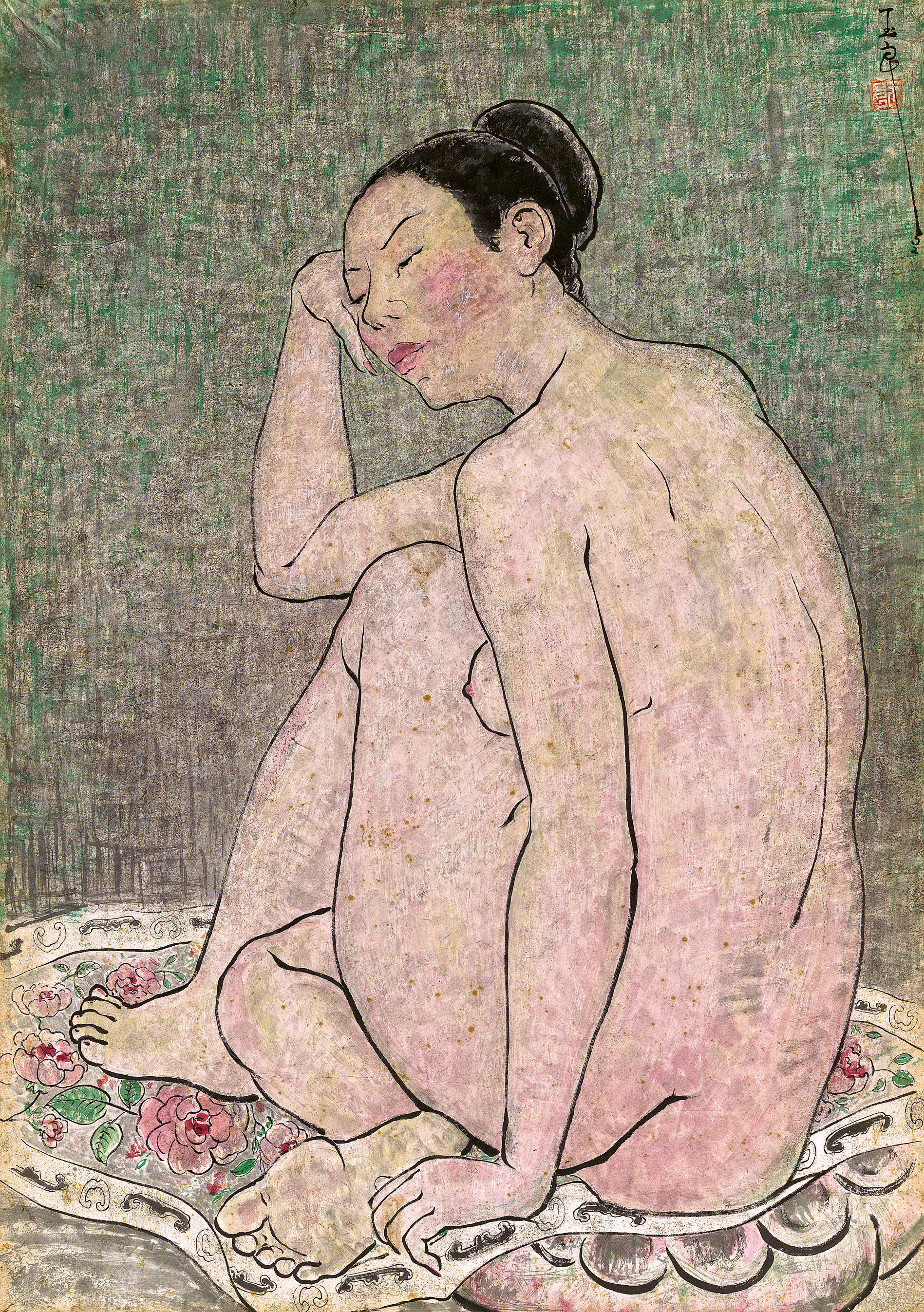
Nude

1952

New fine-line turns the nude into a field of repeated attention

Pan Yuliang's 1952 Nude in ink and color on paper
Image reference: Christie's catalogue. Educational presentation.
Nude100%
Pan Yuliang's 1952 Nude in ink and color on paper

Use the controls or mouse wheel to zoom. Drag the image when enlarged.

Enter the artwork study
06

Object in the Pan Yuliang study

Date
1952
Medium
Ink and colour on paper
Dimensions
91 x 65 cm
Collection / record
Private collection; documented by Christie's
Catalogue / accession
Hong Kong 2010, lot 1066

01 / Why this work matters

New fine-line turns the nude into a field of repeated attention

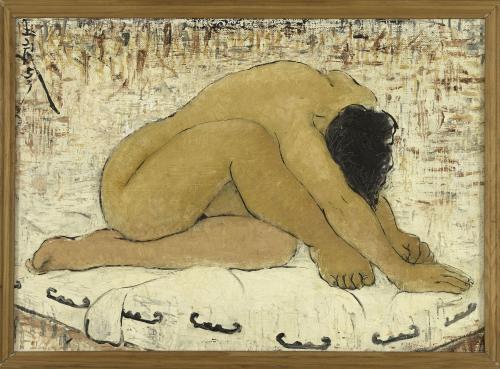
Thousands of short, fine marks gather around the body, giving flesh volume without the continuous contour or smooth shadow of academic drawing. Color wash passes through this linear mesh, allowing the figure to feel solid and permeable at once.

Pan's nude is best understood as an authored body rather than a symbol of East-West fusion. A woman trained in life drawing selects the pose, organizes the gaze, and retools both Chinese line and European anatomy. Repetition registers sustained observation rather than passive display.

02 / Formal analysis

Five ways to read the visible evidence.

Move from color and composition toward the material surface and the space the work asks you to inhabit.
01

Color and light

Color remaining translucent beneath the linear web

02

Composition and rhythm

Fine parallel marks changing direction around joints and torso

03

Line and gesture

The pose occupying space without theatrical props

04

Surface and material

Pan's nude is best understood as an authored body rather than a symbol of East-West fusion. A woman trained in life drawing selects the pose, organizes the gaze, and retools both Chinese line and European anatomy. Repetition registers sustained observation rather than passive display.
05

Space and scale

Thousands of short, fine marks gather around the body, giving flesh volume without the continuous contour or smooth shadow of academic drawing. Color wash passes through this linear mesh, allowing the figure to feel solid and permeable at once.

03 / History and object record

Place the image inside a life, a period, and a documented record.

Historical interpretation

Pan Yuliang, 1952

Pan's nude is best understood as an authored body rather than a symbol of East-West fusion. A woman trained in life drawing selects the pose, organizes the gaze, and retools both Chinese line and European anatomy. Repetition registers sustained observation rather than passive display.

The painter and sculptor who claimed the modern body, the self-portrait, and Chinese line as sites of authorship across Shanghai, Rome, and Paris.

Exhibition and record history

What the cited record establishes

Recorded collection
Private collection; documented by Christie's
Catalogue reference
Hong Kong 2010, lot 1066
Exhibition chronology
The cited public record does not provide a complete exhibition chronology. Follow the primary record for provenance, display history, and future updates.

04 / Connections

Continue through neighboring works and parallel modernisms.

05 / Sources and further reading

Follow the object back to its institutional record.